PRINCELY AUTHORITY AND THE CAPITAL
During the reign of Petru I Mușatin, a fully formed Moldavian state authority emerged for the first time, with all the essential attributes of a medieval state: political independence, military capability, and religious autonomy. The choice of Suceava as the main princely residence reflects this stage of power consolidation.
FORTRESSES AND THE PRINCELY COURT
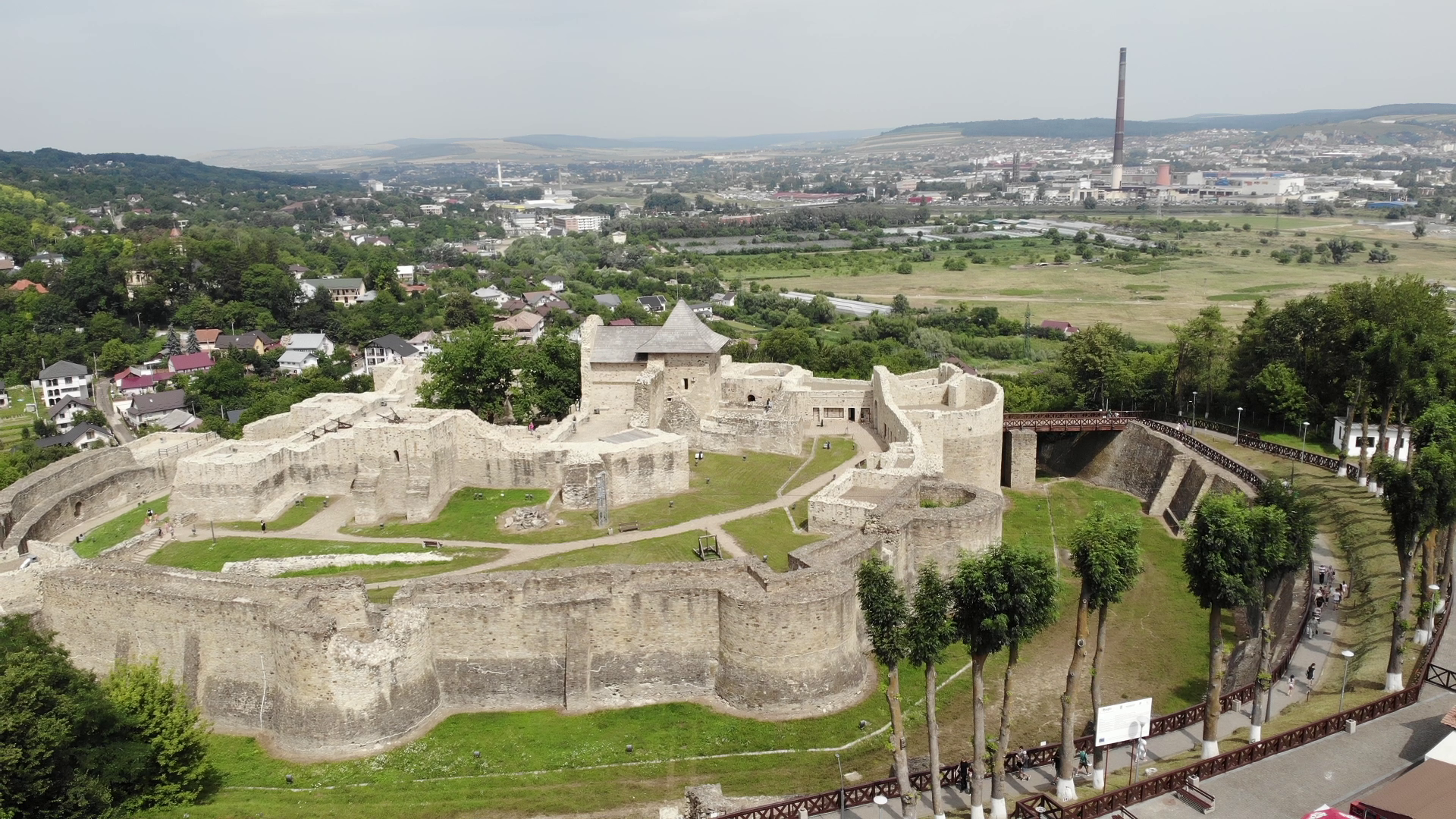
A major construction effort, initiated by the voivode, established a durable defensive system, preserved over centuries with minor modifications. Two successive fortresses were built in Suceava: first, one in the western part of the city, used for a short period, and then the eastern fortress, today known as the Princely Fortress, whose ruins are still visible. In the city center, the princely court was built, serving as the administrative and political nucleus of medieval Moldavia.
THE METROPOLITAN DIOCESE OF MOLDAVIA
During this period, the Metropolitan Diocese of Moldavia was also established, with its seat in Suceava, around the Mirăuți Church. The first metropolitan was Iosif, mentioned in sources as “a relative of the voivode.” The establishment of the metropolitanate was of major importance, as it affirmed the religious autonomy of the Moldavian state. However, the Patriarch of Constantinople contested the voivode’s initiative to appoint his chosen metropolitan and applied an anathema, a religious sanction temporarily excluding the ruler and the entire population from the church community. This sanction was lifted only during the reign of Alexandru cel Bun.
THE MOLDAVIAN TRADE ROUTE
All these achievements required considerable financial resources, mainly provided by taxes from the recently established moldavian trade route. Likely functional after 1380, when the city of Lviv received trading privileges, this trade route connected northern and southern Europe and brought significant revenue to the princely treasury. The route started from Lviv, passing through Halych, Kolomyia, Chernivtsi, Siret, Suceava, Iași, Tighina, and Cetatea Albă, from where goods were shipped by sea to Constantinople. Suceava held a central position in this network, hosting the main customs office, the state mint, and the princely treasury which explains its dominant role in the economic and political life of the state.
THE DOCUMENT OF 1388
A key document for the history of the city and the Moldavian state is the act issued by Petru I in Suceava in 1388. Its drafting in the Suceava Fortress confirms its existence at that date. The loan granted by the voivode to the King of Poland, Władysław, amounting to 3,000 French Frankish? rubles—equivalent to approximately 52 kilograms of fine gold—illustrates Moldavia’s economic capacity. As collateral, the Polish king pledged Pokutia, a Polish province on Moldavia’s northern border. Since the loan was never repaid, Pokutia became a subject of military and diplomatic disputes between Moldavia and Poland for nearly two centuries.
The reconstruction of a fortress wall and the decorative elements—enameled discs and buttons discovered during archaeological excavations at the Princely Fortress—provide insight into the artistic refinement of the era. The symbolic dimension of princely power is also illustrated by the scene of the reception of the relics of Saint John the New of Suceava, represented in the painting of the porch of the “Resurrection of the Lord” Church at Sucevița Monastery, where Alexandru cel Bun, his family, and courtiers appear in a solemn gesture affirming political and religious authority.
All these achievements—fortifications, princely court, Metropolis, trade routes, and treasury—shape the image of a strong Suceava, the political, religious, and economic center of medieval Moldavia. Observing these elements, we understand how the voivode and his community succeeded in transforming the city into a symbol of authority and state stability in the first decades of its existence. Already during the reign of Roman I, Petru’s successor, Moldavia stretched from the Ceremuș River in the north to Cetatea Albă in the south, the Carpathians in the west, and the Dniester in the east.
SUCEAVA HISTORY MUSEUM