WEAPONS AND MILITARY ORGANIZATION
The Arms Hall gathers some of the most valuable pieces in the History Museum’s collection and illustrates the level of military organization achieved by medieval Moldavia. Most of the weapons on display come from archaeological discoveries and cover a wide chronological range, from the 13th century to the 15th–16th centuries. The earliest pieces date to the 13th century and come from the mountainous area of Suceava County, where at Coșna-Floreni a deposit of objects, including weaponry, was found. The period of greatest representation, however, is the 15th–16th centuries, when Moldova had a strong fortress-based military system.
THE DEFENSIVE SYSTEM
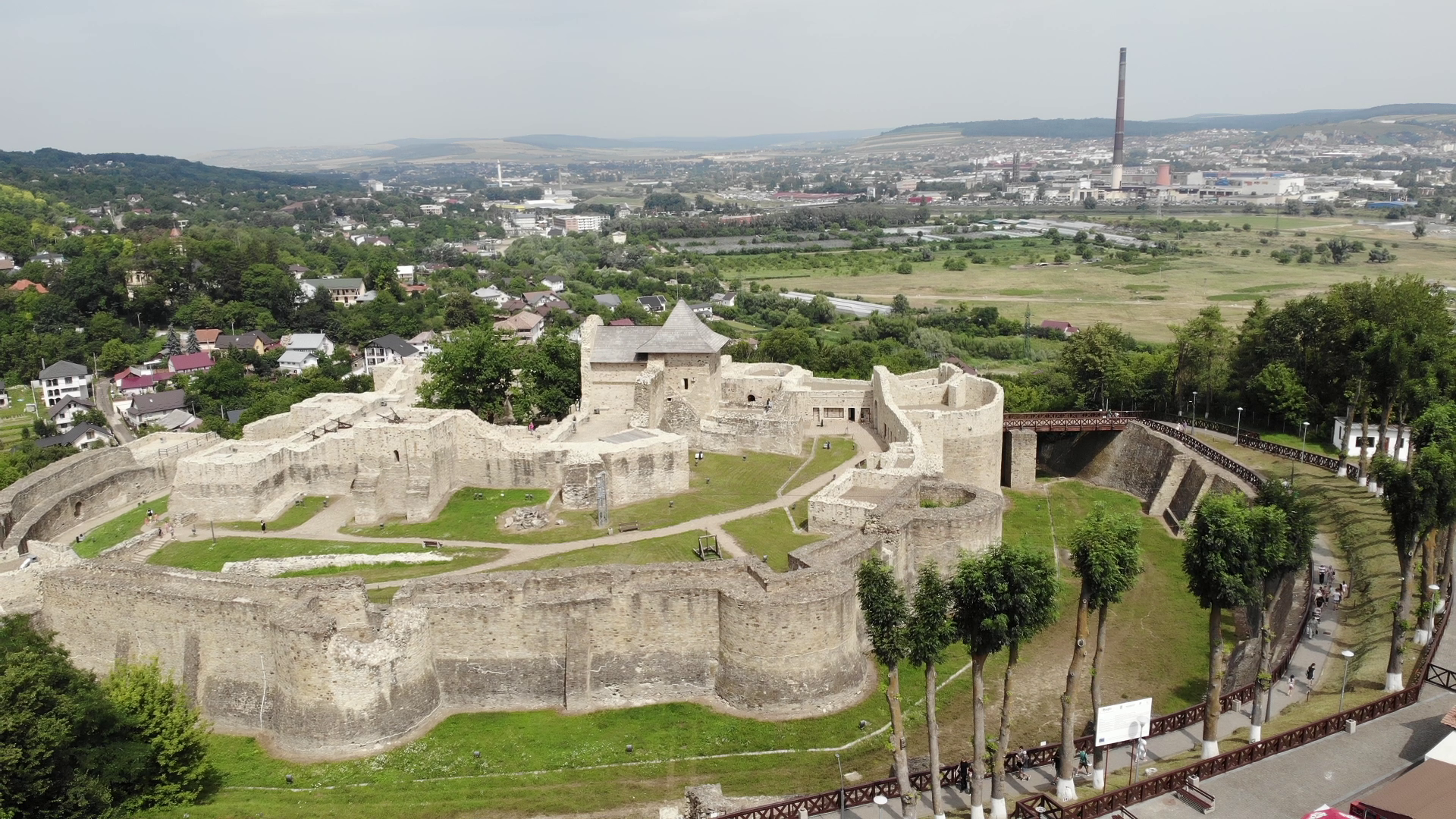
The defensive system of Moldavia was initiated by Petru I Mușatinul and developed by his successors. The spread of artillery in the mid-15th century required major adaptations of fortifications. During the reign of Ștefan cel Mare, the Princely Fortress of Suceava was substantially modified: the old defensive moat was filled in, a new enclosure wall was built in two stages, and a new moat, with a counter-scarp, was dug on the south, west, and east sides. These works are confirmed by fragmentary inscriptions.
The strategic importance of fortresses is also reflected in the political structure of the state. Ștefan cel Mare introduced the Suceava gatekeeper and fortress commanders into the princely council, highlighting the decisive role of military leaders in governing Moldova. Improving the army’s combat capacity was a constant concern. Commercial documents attest to the ongoing efforts of the princely court to acquire weapons from foreign merchants, while master armorers are mentioned in cities such as Suceava. Alongside high-quality imported weapons from Hungary, Poland, and German states, local craftsmen also produced swords, arrowheads, and axes.
THE MEDIEVAL ARSENAL
By the second half of the 15th century, the Moldovan army possessed all categories of weapons known in Europe. The Western sword, with a straight double-edged blade over a meter long, was used for both attack and defense in close combat. The halberd, a complex weapon combining axe, hook, and spear point, was extremely effective against cavalry, allowing strikes that could unbalance mounted opponents. Arrowheads were used by archers for long-range attacks or fortress defense, while simple or oriental recurved bows allowed precise shots over long distances. Lances, spears, and daggers completed the infantry arsenal, used to break cavalry formations or defend passes.
DEFENSE AND BATTLE TACTICS
Shields and armor were essential for protection. Round or rectangular shields defended soldiers during assaults, while chainmail or plate armor protected the body while still allowing movement in combat. Tactically, battles took place both on open fields and during fortress assaults. Soldiers formed compact formations, with archers in the rear and spear infantry in front to stop cavalry. During sieges, wooden towers, siege ladders, and catapults were used, while defenders responded with arrows, stones, and boiling oil. Fortresses had moats, counter-scarps, and towers, all designed to maximize defensive advantage.
WEAPONS AS SYMBOLS OF PRESTIGE
Beyond their practical function, many of the weapons on display were symbols of status and prestige. Swords were often decorated, spearheads bore inscriptions or engravings, and shields displayed heraldic motifs. Thus, combat was not only a physical confrontation but also a demonstration of power, military skill, and strategic organization.
After seeing how medieval Moldova defended itself and organized its army, the next room takes us into the reign of Ștefan cel Mare, when the army, fortresses, and state administration reached peak efficiency, and Moldova demonstrated its strength on the political and military stage of the region.
SUCEAVA HISTORY MUSEUM